#include <cctype>#include <cstdio>#include <sstream>#include <string>#include <vector>#include "REMORA_DateClock.H"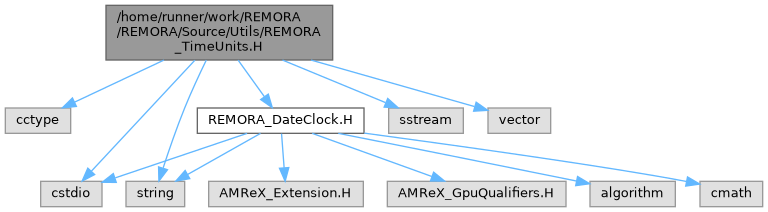
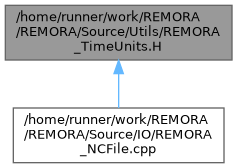
Go to the source code of this file.
Classes | |
| struct | REMORATimeUnits |
| A parsed CF time-units attribute. More... | |
Namespaces | |
| namespace | remora_time_units_detail |
Functions | |
| std::string | remora_time_units_detail::lower (std::string s) |
| bool | remora_time_units_detail::parse_clock (const std::string &tok, REMORATimeUnits &out) |
hh:mm[:ss[.s]], optionally suffixed z. Fills the time fields on success. | |
| bool | remora_time_units_detail::parse_date (const std::string &tok, REMORATimeUnits &out) |
| bool | remora_time_units_detail::is_utc (const std::string &tok) |
| A time-zone designator that means UTC. | |
| bool | remora_parse_time_units (const std::string &units, REMORATimeUnits &out, std::string &error) |
| Parse a CF time-units attribute. | |
| double | remora_time_units_offset_days (const REMORATimeUnits &units, double time_ref) |
Days to add to a time counted from units' reference date to count it from the date time_ref names instead. | |
| bool | remora_calendar_matches_time_ref (const std::string &calendar, double time_ref) |
Whether a CF calendar attribute names the calendar time_ref selects. | |
| std::string | remora_time_units_date_string (const REMORATimeUnits &units) |
The reference date of units as YYYY-MM-DD hh:mm:ss. | |
Detailed Description
The CF units attribute of a NetCDF time variable, and how it maps onto the model clock.
A forcing, boundary, river or climatology file stamps its records with a time variable whose units read days since <date>, or just days. The model clock counts from the date remora.time_ref names (see REMORA_DateClock.H), so a file time is on the model clock only after the difference between the two reference dates is added:
model days = file days + (datenum(file reference) - datenum(time_ref))
remora_time_units_offset_days computes that bracket, in the calendar time_ref selects. It is zero when the file counts from the same date as the run, which is the usual case, and a file with no reference date is taken to be on the model clock already.
remora_parse_time_units reads the attribute. It accepts the CF form, <unit> since YYYY-MM-DD[ hh:mm[:ss[.s]]][ UTC|Z|+00:00], and it skips words between since and the date, so days since initialization, 2020-01-01 00:00:00 reads as 2020-01-01. It does not interpret a time zone other than UTC. Host only: it works on std::string.
Definition in file REMORA_TimeUnits.H.
Function Documentation
◆ remora_calendar_matches_time_ref()
|
inline |
Whether a CF calendar attribute names the calendar time_ref selects.
360_day goes with time_ref = -1 and nothing else. Every other time_ref is Gregorian: gregorian, standard and proleptic_gregorian all agree for dates after 1582, which is where the model clock lives. julian, noleap and the rest count days differently and are rejected.
Definition at line 222 of file REMORA_TimeUnits.H.
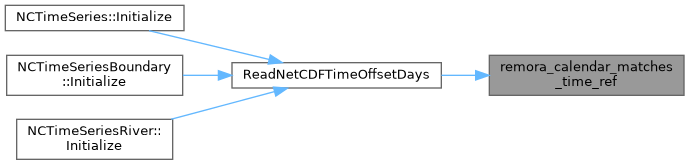
Referenced by ReadNetCDFTimeOffsetDays().

◆ remora_parse_time_units()
|
inline |
Parse a CF time-units attribute.
- Parameters
-
[in] units the attribute text, e.g. days since 2020-01-01 00:00:00[out] out the unit word and, if given, the reference date [out] error why parsing failed, when it did
- Returns
- whether the attribute parsed. The unit word is not checked here; the caller decides which units it accepts.
Definition at line 135 of file REMORA_TimeUnits.H.
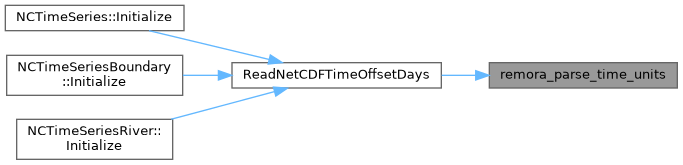
Referenced by ReadNetCDFTimeOffsetDays().

◆ remora_time_units_date_string()
|
inline |
The reference date of units as YYYY-MM-DD hh:mm:ss.
Definition at line 234 of file REMORA_TimeUnits.H.
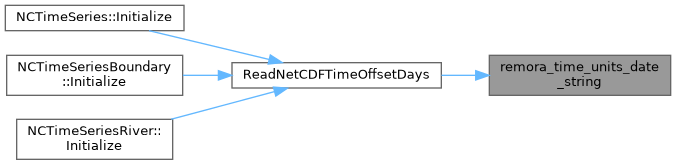
Referenced by ReadNetCDFTimeOffsetDays().

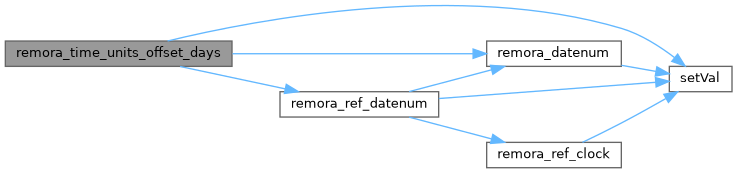
◆ remora_time_units_offset_days()
|
inline |
Days to add to a time counted from units' reference date to count it from the date time_ref names instead.
Zero for a file with no reference date, which is taken to be on the model clock already, and zero when the two dates agree. The day numbers are both taken in the calendar time_ref selects, as remora_caldate does.
Definition at line 204 of file REMORA_TimeUnits.H.
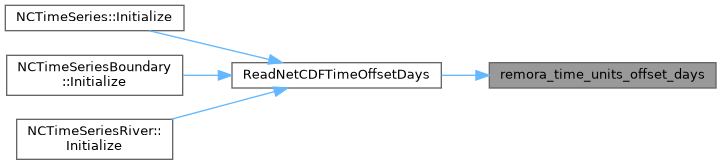
Referenced by ReadNetCDFTimeOffsetDays().